
Best Materials for Cable Sheathing: Why TPEE Material Is Becoming the Preferred Choice
23 May 2026
How to Improve TPEE Part Durability: A Guide for Industrial Manufacturers
7 June 2026When designing high-performance components for automotive, consumer electronics, or industrial machinery, selecting the right material is only half the battle. Thermoplastic Polyester Elastomer (TPEE) is often the top choice for engineers due to its unique combination of flex fatigue resistance, chemical durability, and broad operating temperature range.
However, one critical question remains: How do you choose the right TPEE hardness for your specific application?
Choosing the wrong hardness can lead to premature component failure, manufacturing inefficiencies, or unnecessary material costs. As a global leader and trusted TPEE supplier, Hetroflex® has compiled this engineering guide to help procurement professionals, manufacturing plants, and design engineers navigate TPEE hardness selection with precision.
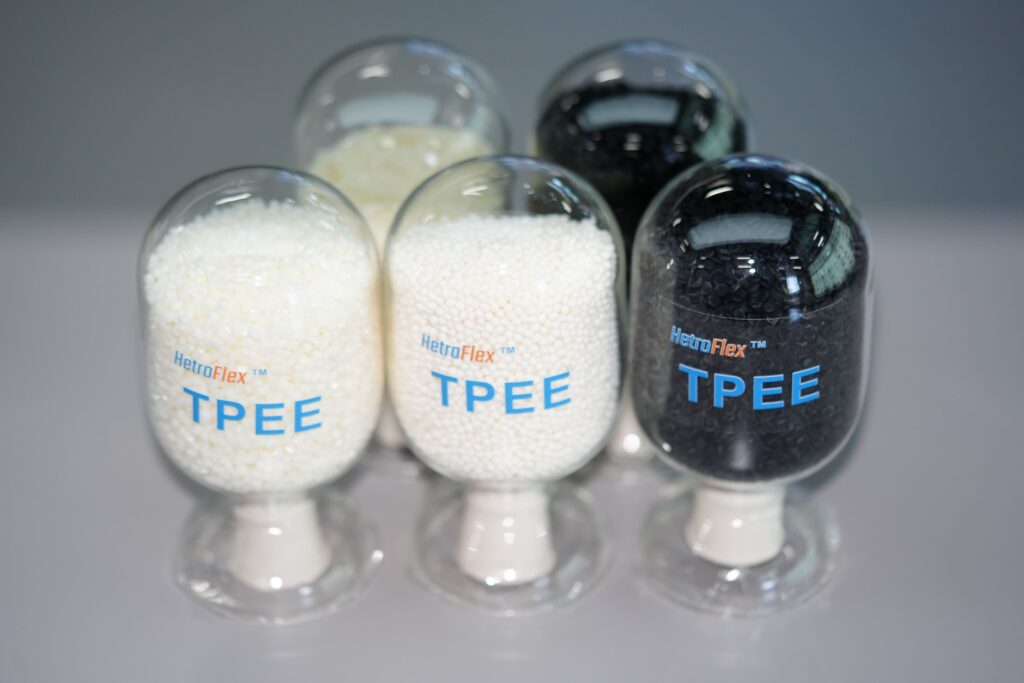
Understanding the TPEE Hardness Range (Shore D vs. Shore A)
Unlike standard rubbers which are typically measured on the Shore A scale, TPEE is a bridge material between rubber and plastics. Consequently, it is most frequently measured using the Shore D hardness scale.
Generally, commercial TPEE grades span from 28 Shore D (highly flexible, rubber-like) up to 82 Shore D (rigid, plastic-like).
- Soft Grades (30D – 40D): Offer high elasticity, excellent low-temperature flexibility, and superior dampening properties.
- Medium Grades (45D – 55D): The “sweet spot” balanced grade offering optimal tensile strength, moderate flexibility, and excellent fatigue resistance.
- Hard Grades (60D – 80D): Deliver high structural rigidity, superior load-bearing capacity, and maximum resistance to chemical abrasion and high temperatures.
Key Factors to Consider When Selecting TPEE Hardness
To ensure you get the exact performance requirements from your TPEE supplier, your engineering and procurement teams should evaluate these three core criteria:
1. Flex Fatigue and Elastic Recovery
Soft TPEE grades (e.g., 35D to 45D) excel in applications requiring repeated bending, such as CVJ (constant velocity joint) boots or flexible couplings. If your product demands high elastic recovery under cyclic stress without cracking, a lower Shore D hardness is ideal.
2. Load-Bearing Capacity and Tensile Strength
As TPEE hardness increases, so does its modulus and tensile strength. For heavy-duty industrial gears, conveyor belt components, or protective housings, hard grades (60D to 72D) are required to withstand high mechanical loads without deforming.
3. Temperature and Chemical Resistance
Harder TPEE grades inherently contain a higher crystalline polyester hard segment. This structural difference allows harder grades to maintain their mechanical properties at elevated temperatures (up to 150°C) and offers superior resistance to oils, greases, and aliphatic hydrocarbons compared to softer grades.
Industry-Specific TPEE Hardness Application Matrix
| Industry Application | Recommended Hardness | Key Performance Requirement |
| Automotive Air Ducts & CVJ Boots | 40D – 55D | Blow molding capability, high-temperature oil resistance, flex life. |
| Industrial Gears & Bearings | 63D – 72D | High load-bearing, abrasion resistance, dimensional stability. |
| Consumer Electronics (Wires/Cables) | 30D – 40D | Soft touch, flame retardancy, low-temperature flexibility. |
| Railway Pad Insulators | 55D – 68D | High impact strength, vibration dampening under extreme loads. |
Why Partnering with the Right TPEE Supplier Matters
For manufacturing plants and raw material distributors worldwide, sourcing TPEE isn’t just about ordering a standard catalog number. It’s about finding a TPEE supplier capable of providing custom-engineered formulations that meet strict OEM specifications.
This is where Hetroflex TPEE stands out in the global market.
The Hetroflex® Advantage: We specialize in supplying high-performance thermoplastic polyester elastomers tailored to your specific processing methods—whether it is injection molding, extrusion, or blow molding. Our global distribution network ensures manufacturing plants and procurement engineers receive consistent quality and expert technical support, regardless of their location.
Conclusion: Optimize Your Material Strategy Today
Selecting the correct TPEE hardness requires balancing flexibility, structural strength, and environmental exposure. By analyzing your application’s mechanical limits and working closely with a specialized developer, you can optimize both product lifespan and manufacturing yield.
Are you a procurement engineer, distributor, or factory manager looking for a reliable global TPEE supplier?
Contact the Hetroflex® engineering team today to request material data sheets (TDS), samples for prototyping, or a custom consultation to determine the exact Shore D hardness required for your next project.
